Learn how to build a content map aligning buyer journey stages with search intent in SEO to attract and convert qualified customers.
Written and published by Blog Post Automatic-O
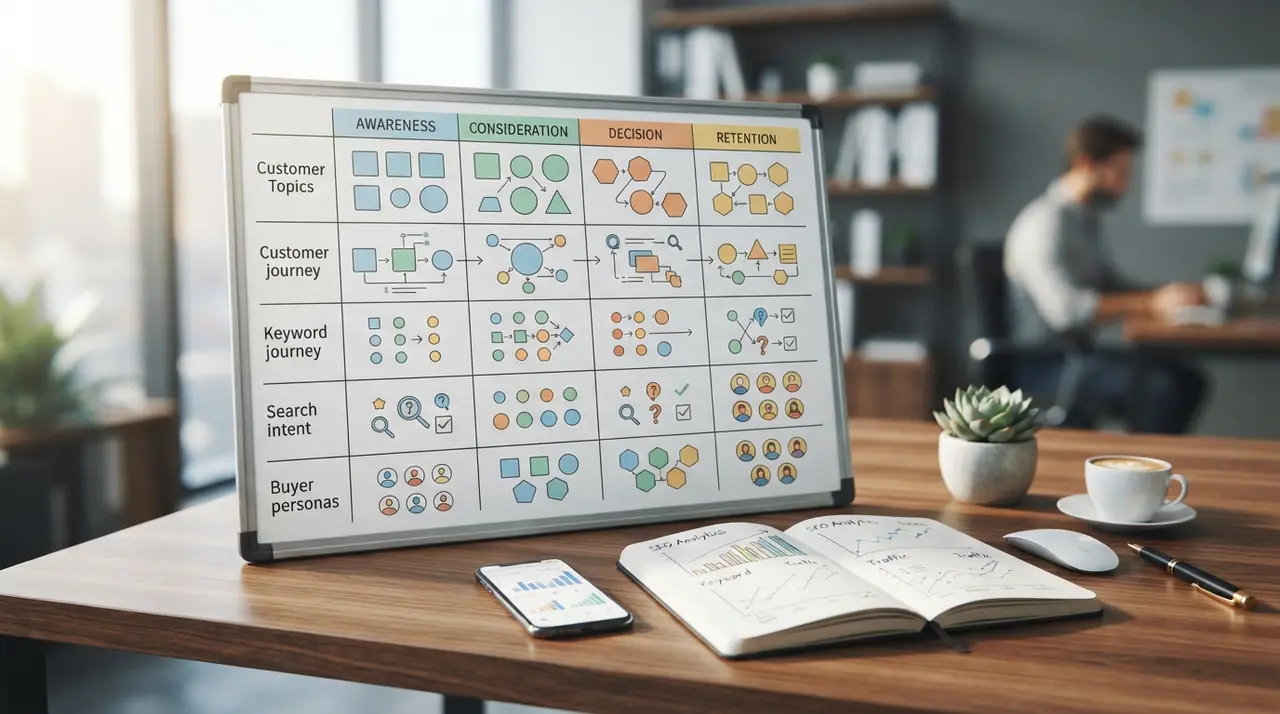
A content map by journey and search intent is a strategic framework that organizes your blog topics according to the customer's maturity stage and the user's intent in SEO. This structure ensures that each article plays a clear role in attracting, nurturing, or converting leads, connecting organic traffic to measurable business results.
The role of the content map in SEO strategy
The content map aligns keywords with the reader's specific decision-making moments to avoid generating traffic with no commercial value. Many companies invest in editorial production but attract only casual visitors because they cover generic topics with no direct link to the purchasability of their product or service.
When the editorial schedule is designed without prior mapping, two recurring problems occur: sales funnel gaps (lack of decision articles) and keyword cannibalization (multiple articles competing for the same term with no defined purpose). Structured planning solves this dispersion by linking each keyword to a clear user need.
The integration between the buyer's journey (awareness, problem, solution, comparison, and decision) and the algorithm's search intent (informational, investigative, transactional, and navigational) transforms the blog from a repository of articles into a predictable customer acquisition channel.
Alignment matrix between customer journey and search intent
The alignment matrix crosses each buyer awareness stage with its respective search intent to identify the correct topic for every moment. By connecting the persona's internal motivation with how they type in the search engine, the company can plan more precise articles with higher conversion rates.
| Journey Stage | Search Intent | Search Example | Content Format | Business Objective |
|---|---|---|---|---|
| Awareness | Informational | "why sales dropped" | Educational article / Introductory guide | Generate visibility and capture initial demand |
| Problem | Informational / Investigative | "how to organize editorial process" | Step-by-step guide / Diagnosis | Build topical authority and contextualize the pain point |
| Solution | Investigative / Commercial | "best tools for B2B blog" | Comparative lists / Automation methods | Present the product category as the answer |
| Comparison | Commercial | "tool X vs solution Y" | Comparative analysis / Pros and cons | Differentiate the offer from market alternatives |
| Decision | Transactional / Navigational | "AI editorial tool pricing" | Case study / Demo page | Convert the reader into an opportunity or customer |
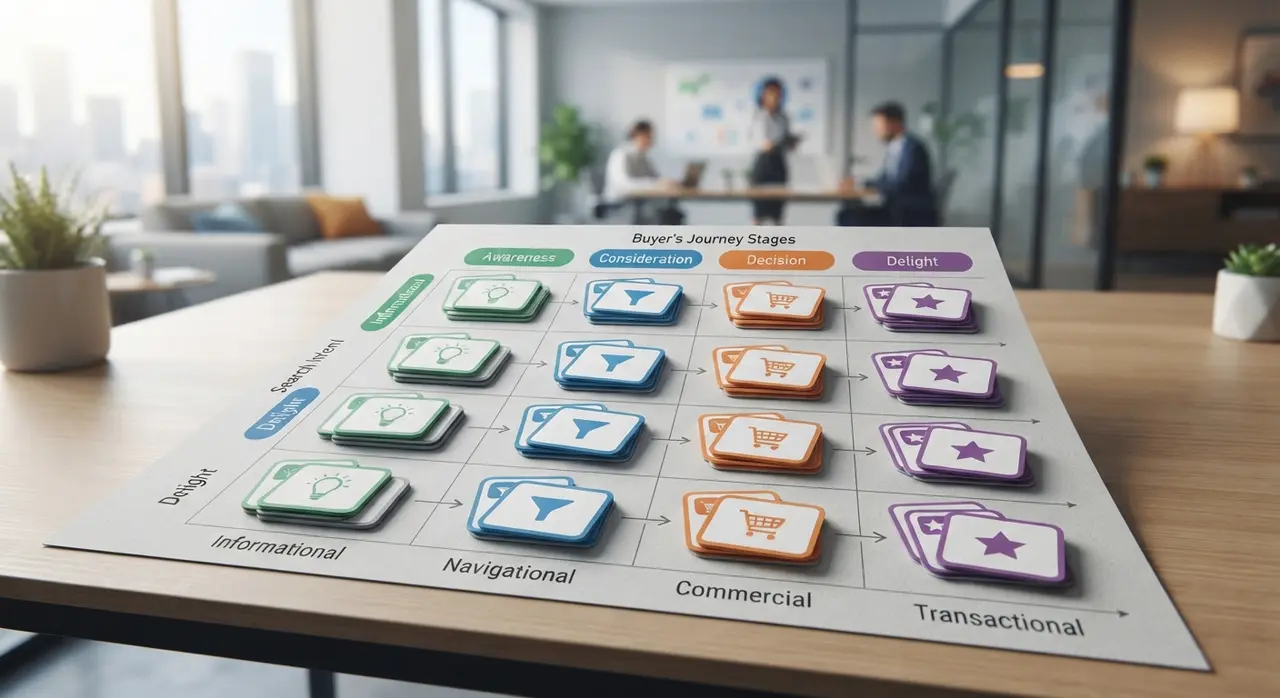
Step-by-step to build and prioritize the content map
Efficiently building a content map requires prioritizing topics by their direct impact on sales before focusing on top-of-funnel attraction. Starting execution with the stages closest to the decision ensures that the first qualified visitors already find clear conversion paths.
- 1. Mapping pain points and commercial hypotheses: Interview the sales and support team to identify the main questions, objections, and comparisons customers make before closing a deal.
- 2. Keyword research and semantic clustering: Identify search terms associated with these questions and group similar keywords into thematic clusters (hub and spoke), avoiding duplicate content.
- 3. Classification by stage and intent: Assign a journey stage (awareness to decision) and the predominant Google search intent to each cluster.
- 4. Prioritization by operational and commercial impact: Start production with comparison and decision articles. Then cover the solution and problem stages to feed the bottom-of-funnel content.
To accelerate the execution of this structure without compromising quality, many companies turn to AI blog content automation, allowing strategic research to transform into optimized articles at greater speed.
Case study: practical application in a B2B company
Restructuring the editorial schedule based on search intent allowed a B2B company to convert qualified visitors into a sales pipeline. Previously, the company maintained a steady volume of generic top-of-funnel publications, attracting high traffic volume that was nevertheless incapable of generating sales meetings.
By implementing an integrated content map, the team prioritized solution comparison articles and bottom-of-funnel implementation guides. Using the infrastructure of BlogPost Automático to support the recurring publication of these clusters, the company covered dozens of commercial intents without overburdening the internal team.
The result was a qualitative shift in traffic: although absolute traffic volume grew in a controlled manner, the visitor-to-scheduled-meeting conversion rate increased significantly. Middle- and bottom-of-funnel articles began feeding sales executives with leads who were better educated about the problem. For tech companies, implementing a B2B SaaS blog to generate leads exemplifies the value of intentional precision over pure volume.

Common mistakes when creating a content map
The most common mistake when planning a content map is focusing solely on search volume and ignoring the user's buying context. High-volume keywords usually have generic intent and require high ranking effort, producing little immediate commercial return.
- Publishing only awareness content: Producing dozens of educational articles without connecting the reader to a practical solution creates a passive audience that does not move down the funnel.
- Ignoring real search intent: Trying to rank an informative article for a keyword with clearly transactional intent frustrates the user and hurts your Google ranking.
- Creating isolated pages without internal links: Top-of-funnel content needs to strategically direct the reader to middle- and bottom-of-funnel articles through contextual links.
- Not reviewing cluster updates: User searches and company products change; a content map must be reviewed periodically to include new market intents.
Frequently asked questions
What is a content map for SEO?
It is a planning tool that organizes blog editorial schedules by mapping keywords to each stage of the customer journey and search intent. The objective is to ensure that the website produces attractive content for both the top and bottom of the funnel.
Which journey stage should I start creating content for?
It is recommended to start with the decision and comparison stages (bottom of the funnel). Creating content for people already looking for a solution ensures capturing existing demand before investing resources into attracting a broader top-of-funnel audience.
How to identify the search intent of a keyword?
Analyze the top results on Google's search page for the desired keyword. If the results are educational articles, the intent is informational; if they are product pages or comparisons, the intent is commercial or transactional.
What is the ideal frequency for updating the content map?
Content map reviews should occur quarterly or whenever new products are launched, commercial strategies change, or new search trends in the target audience are identified.