Learn how to create blog titles that combine SEO, high click-through rates, and clarity. Discover the difference between title tags and H1s and avoid mistakes in your strategy.
Written and published by Blog Post Automatic-O

An SEO title is the structural element that defines how search engines, AI systems, and readers interpret the central topic of an article. To function efficiently, the headline needs to align the user's search intent with a clear and specific content promise.
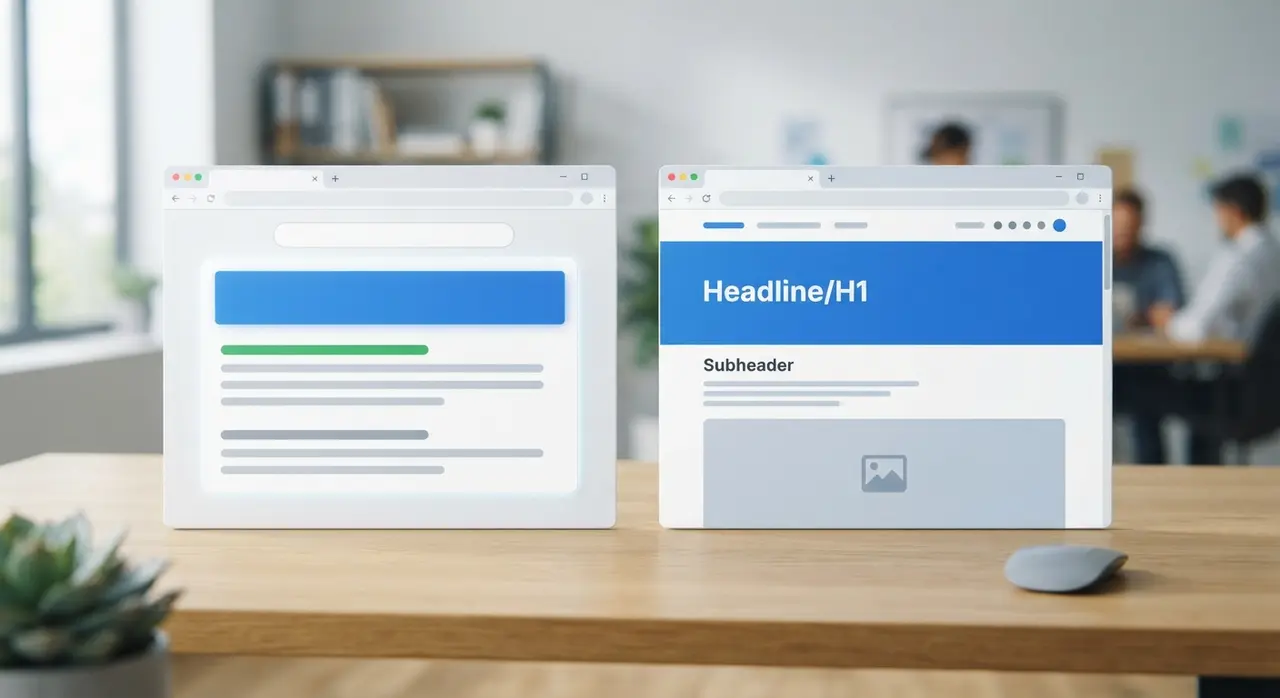
Difference between title tag and H1 title on a blog
The title tag guides the display in Google search results and AI snippets, while the H1 title acts directly on reader navigation within the page. Although both can share the same text, understanding them as distinct elements allows you to optimize both external clicks and internal retention.
The title tag needs to be concise, usually containing between 50 and 60 characters to avoid truncation on search result pages. It should include the main entity and signal the practical value of the article immediately. Meanwhile, the H1, located at the top of the page, has more flexibility in length and can contextualize the reading with more nuance, without the rigid space limitations of search engines.
Adjusting both elements is essential when building a solid internal link architecture, ensuring that search crawlers and readers understand the exact hierarchy of each topic on your site.
How to align search intent with the title's promise
Aligning with search intent requires the title to accurately mirror the real problem the reader wants to solve at the time of search. A common mistake is focusing solely on keyword volume without considering the stage of the journey at which the search is conducted.
If the intent is informational and focused on problem-solving, a purely promotional title will fail to generate clicks. On the other hand, if the user is looking for a clear criterion for a buying decision or model comparison, generic or philosophical titles lose technical and practical relevance.
The table below compares the practical application of titles adjusted by search intent and technical support:
| Criterion | Title Tag (Search Snippet) | H1 Title (In Article) |
|---|---|---|
| Main function | Attract clicks and indicate technical relevance | Confirm expectations and initiate reading |
| Recommended limit | Approximately 50 to 60 characters | No rigid limit (focus on clarity) |
| Primary audience | User in search and crawlers (SEO/GEO) | Reader already on the page |
| Entity inclusion | Mandatory and at the beginning, if possible | Natural within the sentence context |
Essential criteria for building a high-performing headline
High-performing titles combine the inclusion of the main entity with specificity and absolute clarity about the benefit of reading. Combining these factors reduces ambiguity and helps search systems and AI categorize content correctly.
- Explicit entity inclusion: Clearly name the central topic, tool, or concept. Avoid vague terms like "This solution" or "The definitive method".
- Technical specificity: Indicate the context or target audience. An article on "SEO for agencies" attracts a much more qualified audience than a generic text on "SEO".
- Verifiable promise: The title should only promise what the text delivers. Exaggerated promises increase bounce rates and harm long-term rankings.
- Clarity without unnecessary jargon: Use the language that your ideal customer types into search, not your company's internal jargon.
When content is optimized for new AI-based search scenarios, as explained in our guide on AEO, GEO, and SEO, entity precision in the title becomes a crucial factor for the article to be cited as a direct answer.
Mini-case: Title restructuring in a B2B company
The systematic review of titles on a corporate blog can recover organic traffic without needing to rewrite the entire article. A B2B management software company maintained dozens of published articles with generic titles, such as "How to improve your management" or "The future of productivity".
After implementing the editorial methodology used by BlogPost Automático, the team restructured titles focusing on clear entities and precise search intent. Articles with generic titles were rewritten into formats such as "How to Reduce the B2B Sales Cycle: A Practical Guide for Managers".
The qualitative result in 60 days was a significant increase in click-through rate (CTR) in Google Search Console, the indexing of featured snippets in search results, and content citations by AI engines, attracting decision-makers with a high level of commercial intent.

Common mistakes that hurt click-through rates and rankings
Generic titles and exaggerated promises reduce user trust and increase bounce rates on search engines. When a user clicks on an appealing headline but encounters superficial content that fails to deliver on the promise, the dissatisfaction signal sent to the search engine is immediate.
Among the most frequent mistakes in website and blog editorial management, the following stand out:
- Appealing clickbait: Sensational headlines that generate the initial click but destroy brand authority when the reader perceives the lack of depth.
- Keyword stuffing: The artificial repetition of keywords in the title, making the sentence sound robotic and unappealing to humans.
- Ambiguity and lack of context: Titles that are overly poetic or creative and fail to reveal the real subject of the text.
To maintain control over the quality of published content and avoid these flaws, it is essential to establish a clear process for editorial approval in blogs that use AI, ensuring consistency before the article goes live.
Frequently asked questions
What is the difference between a title tag and an H1 title?
The title tag is the title displayed in Google search results and the browser tab, focused on attracting clicks. The H1 title is the main heading inside the article page, responsible for greeting the reader and initiating the content.
What is the ideal length for an SEO title?
The recommended length for a title tag is approximately 50 to 60 characters or up to 600 pixels wide. Keeping the title within this limit prevents it from being truncated with ellipses in search results.
How to include keywords in the title without sounding artificial?
Insert the keyword or main entity naturally within a well-structured sentence with complete meaning. Prioritize clarity for the reader over mechanical repetition of the exact term.
Do question-format titles work better on Google?
Question-format titles work very well when they match the exact query searched by the user. They are especially effective at capturing informational intent and appearing in direct answer search features.