Understand how the rise of zero-click searches and AI search are changing SEO. Learn to focus on brand exposure, citations, and high-intent decision traffic.
Written and published by Blog Post Automatic-O

The zero-click phenomenon occurs when AI search tools and Google's new answer formats resolve user queries directly on the search results page, without requiring a click to an external website. To continue growing organically in this scenario, companies need to shift their focus from raw visit volume to securing strategic citations, brand exposure, and attracting high commercial intent traffic.
The new role of the website in the AI search ecosystem
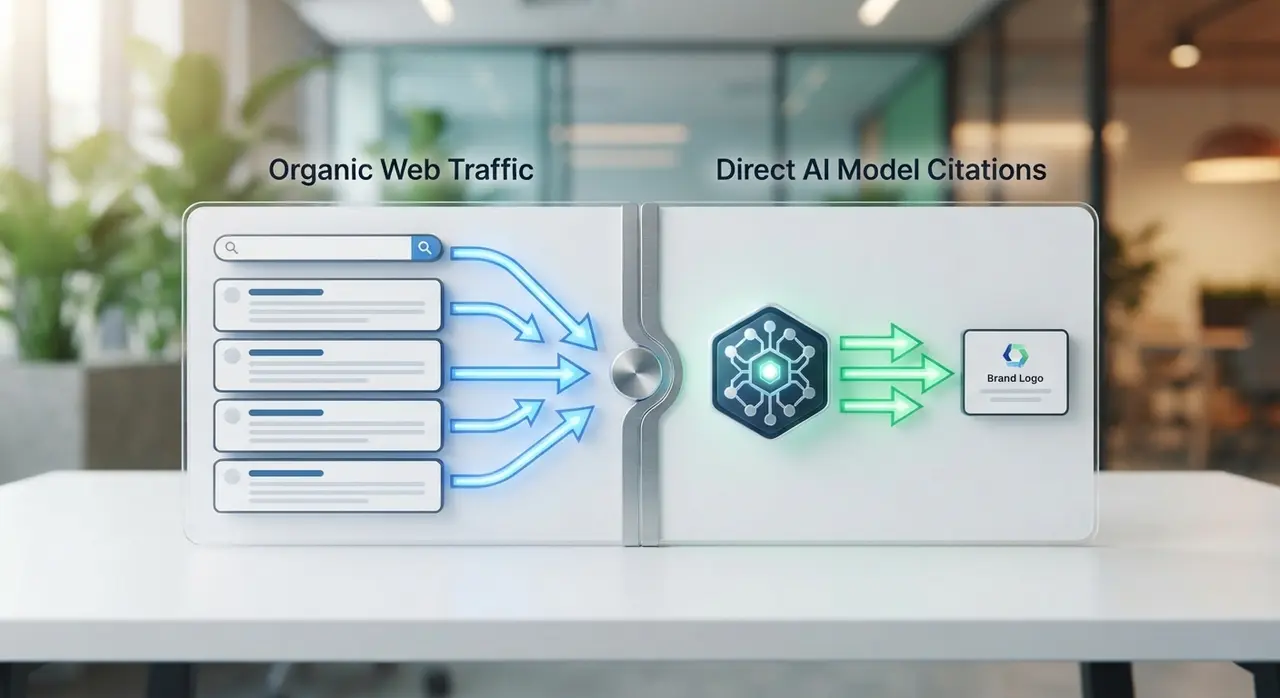
The consolidation of AI-generated answers has redefined owned channels as primary knowledge bases for language models, rather than just generic traffic collectors. When an AI search engine answers a query citing your company as a reference, the value generated comes in the form of reputation, authority building, and brand exposure, even if an immediate click does not occur in that session.
This does not mean the end of organic traffic, but rather a filtering process. Shallow conceptual queries or glossary definitions tend to be consumed directly on the search engine interface. On the other hand, the reader who clicks and visits your site today is much more qualified, having moved past the quick AI response to seek in-depth information, social proof, technical details, or a commercial solution for their needs.
Difference between commodity content and decision content
The survival of organic marketing requires replacing generic content with proprietary materials targeted at critical buying moments. Shallow informational content has been fully absorbed by AI synthesis models, while articles offering practical insights, real frameworks, and technical positioning remain indispensable for human audiences and attract valuable citations from algorithms.
To structure this transition without compromising operational efficiency, it is worth understanding how these two types of content differ in practice:
| Criterion | Commodity Informational Content | Decision and Authority Content |
|---|---|---|
| Main Objective | Answer generic conceptual questions | Help in decision-making and solving complex problems |
| Impact on AI Search | Fully synthesized into zero-click responses | Cited as a reliable source and recommended for reference |
| Traffic Profile | Casual visitors with low buying intent | Qualified readers, decision-makers, and potential clients |
| Information Source | Rewriting existing web articles | Practical experience, proprietary data, and real processes |
| Business Return | Vanity metrics (pageviews only) | Brand building, owned audience, and sales pipeline |
By focusing on developing robust and well-structured pillars, your company starts building topical authority in SEO, ensuring that both readers and AI discovery tools identify your site as the primary industry reference.
How to turn AI citations into real business opportunities
A company's continuous presence in generative answers depends on the consistent publication of specific data and insights that AI models cannot infer on their own. If your company only publishes what everyone else has already said, search engines have no reason to cite your brand as a primary source.
To capture the value of these citations and convert visibility into business opportunities, adopt the following process:
- Work with proprietary concepts and terminology: Make the names of your processes, frameworks, or methodologies clear. AIs tend to directly cite brands that name solutions.
- Create conversion points for an owned audience: Since a portion of visitors will arrive more decisive, offer technical newsletters, tools, diagnostics, or structured materials to convert visits into direct contact.
- Cover the complete search journey: In a concept known as query fan-out, answer ecosystems unpack a single search into multiple related questions. Your content needs to address not only the initial topic, but also the natural follow-up questions that arise.
To better understand how these technologies process and display your content, it is worth delving deeper into the analysis on AI Overviews and generative search.

Summary case study: B2B consultancy and the transition to citation-based visibility
A B2B process management consultancy faced a progressive drop in top-of-funnel traffic due to the growth of direct search answers. By revising its strategy alongside the BlogPost Automático solution workflow, the company replaced conceptual articles on "what is management" with applied diagnostics, implementation guides, and operational trade-off analyses.
As a qualitative result, although the total volume of curious visitors stabilized, the number of quote requests via the blog increased. The brand became frequently cited by AI summaries as a benchmark in efficiency methodologies, attracting clients who arrived at sales meetings already familiar with the company's approach.
Metrics to track in the AI search era
Measuring organic content success in a high zero-click volume scenario requires looking beyond a simple top-of-funnel click count. When the goal shifts to authority and decision influence, the metric dashboard must be adjusted to reflect the true financial and institutional impact of your publications.
Prioritize tracking:
- Impressions and brand reach: Continuous growth in impressions on Google Search Console indicates that your brand is being displayed and associated with the market's most relevant searches.
- Increase in branded searches: Growth in searches for your company's name on Google is a direct indicator that AI citations and zero-click answers are driving brand recall.
- Conversion by qualified visit: Monitor the conversion rate of consideration and decision pages. Less traffic with higher conversions confirms that the content is compelling to the right reader.
- Citations and supporting links: Track how frequently industry portals and AI engines use your site as a supporting source to back up analyses.
Frequently asked questions
Will organic traffic end with the advance of AI search?
No, organic traffic will not end, but its profile will change. Casual visits for simple questions will decrease, while traffic from users interested in deep analysis, expert opinions, and commercial solutions will become more qualified.
How can I ensure my site is cited in AI responses?
Citations in AI tools depend on publishing original information, well-defined concepts, practical data, and clear technical structure. Answer engines prioritize authoritative sources that offer direct responses backed by reliable evidence.
Is it worth continuing to produce content if the user doesn't click?
Yes, it is worth continuing to produce content because direct citations build authority and brand exposure at the exact moment a customer searches for an answer. Furthermore, a user ready to hire or purchase will still click through to your site to validate reputation and make the final decision.